.

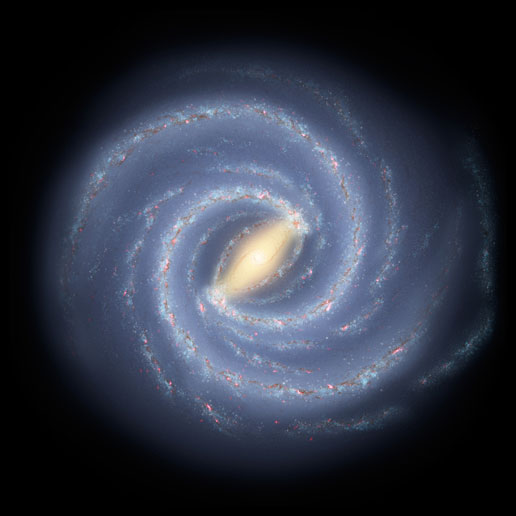
Our Milky Way Galaxy

Saturday, 8 October 2011 | 0 comments

How large is the Milky Way Galaxy ?

The disk of the Milky Way galaxy is about 100,000 light years in diameter (one light year is about 9.5 x 10¹⁵ meters), but only about 1000 light years thick. Our Galaxy contains about 200 billion stars. Most of the stars are located in the disk of our galaxy, which is the site of most of the star formation because it contains lots of gas and dust. The halo, which is a spherical cloud surrounding the disk, contains only about 2% as many stars as the disk. It contains old and cool stars, since it has little gas and dust.


Artist's Rendering Of Kepler's Target Region In The Milky Way

An artists rendering of what our galaxy might look as viewed from outside our Galaxy. Our sun is about 25,000 light years from the center of our galaxy. The cone illustrates the neighborhood of our galaxy that the Kepler Mission will search to find habitable planets. Credit: Jon Lomberg.

Milky Way Galaxy

| 0 comments

Our Milky Way Galaxy


This artist's concept illustrates the new view of the Milky Way
The artist's concept also includes a new spiral arm, called the "Far-3 kiloparsec arm," discovered via a radio-telescope survey of gas in the Milky Way. This arm is shorter than the two major arms and lies along the bar of the galaxy.

Our sun lies near a small, partial arm called the Orion Arm, or Orion Spur, located between the Sagittarius and Perseus arms.


The disk of Our Milky Way Galaxy is home to hot nebulae, cold dust, and billions of stars. This disk can be seen from a dark location on Earth as a band of diffuse light across the sky. This band crosses the sky in dramatic fashion in the above series of wide angle sky.

The deepness of the exposures also brings to light a vast network of complex dust filaments. Dust is so plentiful that it obscures our Galaxy's center in visible light, hiding its true direction. The Galactic Center, though, is visible above as the thickest part of the disk. The diffuse glow comes from billions of older, fainter stars like our Sun, which are typically much older than the dust or any of the nebulae. One particularly photogenic area of darkness is the Pipe Nebula visible above the Galactic Center. Dark dust is not the dark matter than dominates our Galaxy -- that dark matter remains in a form yet unknown.

Most bright stars in Our Milky Way Galaxy reside in a disk. Since our Sun also resides in this disk, these stars appear to us as a diffuse band that circles the sky. The above panorama of a northern band of the Milky Way's disk covers 90 degrees and is a digitally created mosaic of several independent exposures. Scrolling right will display the rest of this spectacular picture. Visible are many bright stars, dark dust lanes, red emission nebulae, blue reflection nebulae, and clusters of stars. In addition to all this matter that we can see, astronomers suspect there exists even more dark matter that we cannot see.

To study our Galaxy, theorists create models of how these different particles interact with magnetic fields in different locations and with different strengths. Astronomers can then compare these models to actual observations made at radio, infrared, optical, ultraviolet, and X-ray wavelengths to see how well they match the data. The LAT will contribute vital data that will enable theorists to constrain and improve their models.

Starbust Galaxy

| 0 comments

Several definitions of the term starburst galaxy exist and there is no strict definition on which all astronomers agree. However, many generally agree that the definition must in some way be related to three factors there are :

(1) The rate at which the galaxy is currently converting gas into stars (the star-formation rate, or SFR)
(2) The available quantity of gas from which stars can be formed
(3) Comparison of the timescale of star formation with the age or rotation period of the galaxy.

A starburst galaxy is a galaxy in the process of an exceptionally high rate of star formation, compared to the usual star formation rate seen in most galaxies. Galaxies are often observed to have a burst of star formation after a collision or close encounter between two galaxies. The rate of star formation is so great for a galaxy undergoing a starburst that, if the rate was sustained, the gas reservoirs from which stars are formed would be used up on timescales much shorter than the age of the galaxy. For this reason, it is presumed that starbursts are temporary. Well-known starburst galaxies include M82, NGC 4038/NGC 4039 (the Antennae Galaxies), and IC 10.

List Of Galaxies

| 0 comments

This is a list of galaxies that are well known by something other than an entry in a catalog or list, or a set of coordinates, or a systematic designation.

Notes
This is the galaxy that contains Earth, it is named after the nebulosity in the night sky that marks the densest concentration of stars of our galaxy in the sky, which appears to blur together into a faint glow, called the Milky Way.
Commonly just Andromeda, this, called the Andromeda Galaxy, Andromeda Nebula, Great Andromeda Nebula, Andromeda Spiral Nebula, and such, has been traditionally called Andromeda, after the constellation in which it lies.
Named for Johann Elert Bode who discovered this galaxy in 1774.
Its visual appearance is similar to that of a spoked cartwheel.
Appears similar in shape to a cigar.
This galaxy is named after its unusual appearance, looking like a comet.
Hoag's Object
This is named after Art Hoag, who discovered this ring galaxy.
Large Magellanic Cloud
Named after Ferdinand Magellan
Small Magellanic Cloud
Named after Ferdinand Magellan
Mayall's Object
This is named after Nicholas U. Mayall, of the Lick Observatory, who discovered it.
Pinwheel Galaxy
Similar in appearance to a pinwheel .
Sombrero Galaxy
Similar in appearance to a sombrero.
Sunflower Galaxy

Tadpole Galaxy
The name comes from the resemblance of the galaxy to a tadpole.
Whirlpool Galaxy
From the whirlpool appearance this gravitationally disturbed galaxy exhibits.
Omega Centauri Once thought to be a star and later a globular cluster, Omega Centauri was confirmed as having a black hole at its center and thus its status has been changed to being a dwarf galaxy as of April 2010.
Triangulum Galaxy Being a diffuse object, its visibility is strongly affected by even small amounts of light pollution, ranging from easily visible in direct vision in truly dark skies to a difficult averted vision object in rural/suburban skies.
Centaurus A Centaurus A has been spotted with the naked eye by Stephen James O'Meara
Bode's Galaxy Highly experienced amateur astronomers may be able to see Messier 81 under exceptional observing conditions
Sculptor Galaxy According to Brian A. Skiff, the naked-eye visibility of this galaxy is discussed in an old Sky & Telescope letter or note from the late 1960s or early 1970s
Messier 83 M83 has reportedly been seen with the naked eye
Starburst Galaxy Several definitions of the term starburst galaxy exist and there is no strict definition on which all astronomers agree. However, many generally agree that the definition must in some way be related
Sombrero Galaxy

Triangulum Galaxy

Antennae Galaxy


What Is Suvernova

| 0 comments

A supernova is a stellar explosion that is more energetic than a nova. Supernovae are extremely luminous and cause a burst of radiation that often briefly outshines an entire galaxy, before fading from view over several weeks or months. During this short interval a supernova can radiate as much energy as the Sun is expected to emit over its entire life span. The explosion expels much or all of a star's material at a velocity of up to 30,000 km/s (10% of the speed of light), driving a shock wave into the surrounding interstellar medium. This shock wave sweeps up an expanding shell of gas and dust called a supernova remnant.


Historical supernovae are known simply by the year they occurred: SN 185, SN 1006, SN 1054, SN 1572 (called Tycho's Nova) and SN 1604 (Kepler's Star). Since 1885 the additional letter notation has been used, even if there was only one supernova discovered that year (e.g. SN 1885A, SN 1907A, etc.) — this last happened with SN 1947A. SN, for SuperNova, is a standard prefix. Until 1987, two-letter designations were rarely needed; since 1988, however, they have been needed every year.

As part of the attempt to understand supernovae, astronomers have classified them according to the absorption lines of different chemical elements that appear in their spectra. The first element for a division is the presence or absence of a line caused by hydrogen. If a supernova's spectrum contains a line of hydrogen (known as the Balmer series in the visual portion of the spectrum) it is classified Type II; otherwise it is Type I. Among those types, there are subdivisions according to the presence of lines from other elements and the shape of the light curve (a graph of the supernova's apparent magnitude as a function of time).

What Is Asteroid

| 0 comments

Asteroids are a class of Small Solar System Bodies in orbit around the Sun. They have also been called planetoids, especially the larger ones. These terms have historically been applied to any astronomical object orbiting the Sun that did not show the disk of a planet and was not observed to have the characteristics of an active comet, but as small objects in the outer Solar System were discovered, their volatile-based surfaces were found to more closely resemble comets, and so were often distinguished from traditional asteroids. Thus the term asteroid has come increasingly to refer specifically to the small rocky–icy and metallic bodies of the inner Solar System out to the orbit of Jupiter.


There are millions of asteroids, many thought to be the often shattered remnants of planetesimals, bodies within the young Sun’s solar nebula that never grew large enough to become planets. A large majority of known asteroids orbit in the asteroid belt between the orbits of Mars and Jupiter or co-orbital with Jupiter (the Jupiter Trojans). However, other orbital families exist with significant populations, including the near-Earth asteroids. Individual asteroids are classified by their characteristic spectra, with the majority falling into three main groups: C-type, S-type, and M-type. These were named after and are generally identified with carbon-rich, stony, and metallic compositions, respectively.

It is believed that planetesimals in the asteroid belt evolved much like the rest of the solar nebula until Jupiter neared its current mass, at which point excitation from orbital resonances with Jupiter ejected over 99% of planetesimals in the belt. Simulations and a discontinuity in spin rate and spectral properties suggest that asteroids larger than approximately 120 km (75 mi) in diameter accreted during that early era, whereas smaller bodies are fragments from collisions between asteroids during or after the Jovian disruption.

What Is Blackhole

| 0 comments

A black hole is a region of spacetime from which nothing, not even light, can escape. The theory of general relativity predicts that a sufficiently compact mass will deform spacetime to form a black hole. Around a black hole there is a mathematically defined surface called an event horizon that marks the point of no return. It is called "black" because it absorbs all the light that hits the horizon, reflecting nothing, just like a perfect black body in thermodynamics


Black holes of stellar mass are expected to form when massive stars collapse in a supernova at the end of their life cycle. After a black hole has formed it can continue to grow by absorbing mass from its surroundings. By absorbing other stars and merging with other black holes, supermassive black holes of millions of solar masses may be formed.

Considering the exotic nature of black holes, it may be natural to question if such bizarre objects could exist in nature or to suggest that they are merely pathological solutions. This led the general relativity community to dismiss all results to the contrary for many years. However, a minority of relativists continued to contend that black holes were physical objects, and by the end of the 1960s, they had persuaded the majority of researchers in the field that there is no obstacle to forming an event horizon.

What Is Nebula

| 0 comments

What Is Nebula..?
A nebula , nebulae or nebulæ, with ligature or nebulas is an interstellar cloud of dust, hydrogen gas, helium gas and other ionized gases. Originally, nebula was a general name for any extended astronomical object, including galaxies beyond the Milky Way (some examples of the older usage survive; for example, the Andromeda Galaxy was referred to as the Andromeda Nebula). 

Nebulae often form star-forming regions. In these regions the formations of gas, dust, and other materials "clump" together to form larger masses, which attract further matter, and eventually will become massive enough to form stars. The remaining materials are then believed to form planets, and other planetary system objects.


There are some Notable named nebulae


Ant Nebula
Barnard's Loop
Boomerang Nebula
Cat's Eye Nebula
Crab Nebula
Cone Nebula
Eagle Nebula
Egg Nebula
Eskimo Nebula
Eta Carinae Nebula
Helix Nebula
Kronberger 61
Lagoon Nebula

Hourglass Nebula
Horsehead
NebulaLagoon Nebula
Omega Nebula
Orion Nebula
Pacman Nebula
Pelican Nebula
Red Square Nebula
Red Rectangle Nebula
Ring Nebula
Rosette Nebula
Tarantula Nebula
Trifid Nebula


The History Of Meteor

| 0 comments

History Of Meteor

Although meteors have been known since ancient times, they were not known to be an astronomical phenomenon until early in the 19th century. Prior to that, they were seen in the West as an atmospheric phenomenon, like lightning, and were not connected with strange stories of rocks falling from the sky. Thomas Jefferson wrote "I would more easily believe that (a) Yankee professor would lie than that stones would fall from heaven." He was referring to Yale chemistry professor Benjamin Silliman's investigation of an 1807 meteorite that fell in Weston, Connecticut. Silliman believed the meteor had a cosmic origin, but meteors did not attract much attention from astronomers until the spectacular meteor storm of November 1833. People all across the eastern United States saw thousands of meteors, radiating from a single point in the sky. Astute observers noticed that the radiant, as the point is now called, moved with the stars, staying in the constellation Leo.


The astronomer Denison Olmsted made an extensive study of this storm, and concluded it had a cosmic origin. After reviewing historical records, Heinrich Wilhelm Matthias Olbers predicted its return in 1867, which drew the attention of other astronomers. Hubert A. Newton's more thorough historical work led to a refined prediction of 1866, which proved to be correct. With Giovanni Schiaparelli's success in connecting the Leonids (as they are now called) with comet Tempel-Tuttle, the cosmic origin of meteors was now firmly established. Still, they remain an atmospheric phenomenon, and retain their name "meteor" from the Greek word for "atmospheric".

Earth moves at about 30 km/s in its orbit. Meteoroids also have significant orbital speeds. The differences in velocities where these orbits intersect combined with the gravitational attraction of Earth result in the velocities observed for meteors.

What is Meteor

| 0 comments

Meteor is a fast-moving streak of light in the night sky caused by the entry of extraterrestrial matter into the earth's atmosphere, A meteor, commonly called a shooting star and falling star, is the visible trace of a meteoroid as it enters the atmosphere. If it survives impact with the Earth's surface, then it is called a meteorite.

meteor

A meteor is the visible path of a meteoroid that has entered the Earth's atmosphere. Meteors typically occur in the mesosphere, and most range in altitude from 75 km to 100 km. Millions of meteors occur in the Earth's atmosphere every day. Most meteoroids that cause meteors are about the size of a pebble. They become visible between about 40 and 75 miles (65 and 120 kilometers) above the Earth. They disintegrate at altitudes of 30 to 60 miles (50 to 95 kilometers).

.

 
© Copyright 2010-2011 What Is Galaxy All Rights Reserved.
Template Design by Herdiansyah Hamzah | Published by Borneo Templates | Powered by Blogger.com.