.
Showing posts with label The Galaxy. Show all posts

Comet Galaxy

Monday, 10 October 2011 | 0 comments

The “Comet Galaxy
This galaxy has a little more mass than our Milky Way , detected on 2nd March of 2007 The “Comet Galaxy”  is actually just one galaxy located in a distant galaxy cluster known as Abell 2667, located about 3.2 billion light-years from Earth.

It's named Comet Galaxy because shows a tail with a length of 600,000 light years. The main reasons of the Comet galaxy tails is the gas and stars of the galaxy are being stripped away by the tidal forces of the cluster. The comet galaxy is currently being ripped to pieces. Moving through a cluster at speeds of greater than 2 million mph. Other factors adding to the damage of the galaxy are the cluster's scorching gas plasma. As the galaxy speeds through, its gas and stars are being stripped away by the tidal forces exerted by the cluster - just as the tidal forces exerted by the moon and Sun push and pull the Earth's oceans.

Scientists estimate that the total duration of the transformation process is close to one billion years. What is seen now in the Hubble image is roughly 200 million years into the process.Even though the Comet Galaxy’s mass is slightly greater than the Milky Way, it will lose all its gas and dust, and so not be able to generate stars later in life. It will become a gas-poor galaxy with an old population of red stars.

Black Eye Or Evil Eye Galaxy

Sunday, 9 October 2011 | 0 comments

Black eye galaxy also known as Evil Eye Galaxy are called Sleeping Beauty Galaxy or Messier 64 It has a spectacular dark band of absorbing dust in front of the galaxy's bright nucleus, giving rise to its nicknames of the "Black Eye" or "Evil Eye" galaxy. It is well known among amateur astronomers because of its appearance in small telescopes. A relatively nearby spiral galaxy with a conspicuous dark feature to one side of the bright nucleus. Discovered by Johann Bode in 1779. Although M64 can be glimpsed with good binoculars, the oval eye only starts to show in telescopes of 10- to 15-cm aperture.


At first glance, M64 seems to be a fairly normal spiral galaxy. As in the majority of galaxies, all of the stars in M64 are orbiting in the same direction, clockwise as seen in the Hubble image. However, recent detailed studies have led to the remarkable discovery that the interstellar gas in the outer regions of M64 rotates in the opposite direction from the gas and stars in the inner regions. The inner region has a radius of only approximately 3,000 light-years, while the outer section extends another 40,000 light-years. This pattern is believed to trigger the creation of many new stars around the boundary separating the two regions.

Recently there are A collision of two galaxies has left a merged star system with an unusual appearance as well as bizarre internal motions. Messier 64 (M64) has a spectacular dark band of absorbing dust in front of the galaxy's bright nucleus, giving rise to its nicknames of the "Black Eye" or "Evil Eye" galaxy.

Fine details of the dark band are revealed in this image of the central portion of M64 obtained with the Hubble Space Telescope. M64 is well known among amateur astronomers because of its appearance in small telescopes. It was first cataloged in the 18th century by the French astronomer Messier. Located in the northern constellation Coma Berenices, M64 resides roughly 17 million light-years from Earth.
This rubbing may explain the vigorous burst of star formation that is currently taking place in the galaxy and is visible as blue knots embedded in the huge dust lane. The strange disk and dust lane, according to one theory, may be the result of material from a former companion galaxy that has been accreted but has yet to settle into the orbital plane of the disk. Another suggestion is that M64 may be the prototype for a class of galaxies called ESWAG, or evolved second wave activity galaxy. According to this idea, the main spiral pattern consists of an intermediate-aged stellar population. Star formation first evolved outside the current “black eye” region, following the density gradient, manufacturing stars as long as there was enough interstellar matter available, and then slowly died out. As matter was re-released into space from the evolved stars, by way of stellar winds, supernovae, and planetary nebulae, more and more interstellar matter accumulated again, until finally there was enough to enable a new wave of star formation to begin. This second wave, the theory maintains, has now reached the region where the dark dust lane appears.

The Cigar Galaxy also known as Messier 82

| 0 comments

The Cigar Galaxy also known as Messier 82 or  NGC 3034 is the prototype nearby The Starburst Galaxy about 12 million light-years away M82 appears high in the northern spring sky in the direction of the constellation Ursa Major, the Great Bear. It is also called the 'Cigar Galaxy' because of the elongated elliptical shape produced by the tilt of its starry disk relative to our line of sight.


This infrared image from NASA's Spitzer Space Telescope shows a galaxy that appears to be sizzling hot, with huge plumes of smoke swirling around it. The galaxy, known as Messier 82 or the "Cigar galaxy," is in fact, smothered in smoky dust particles (red) blown out into space by the galaxy's hot stars (blue).

Studies using the Hubble Space Telescope have suggested that stars are being born within M82 at a rate ten times that of the Milky Way. Previously thought to be an irregularly shaped galaxy, M82 is now known to be hiding two spiral arms.

The Cartwheel Galaxy ESO 350-40

| 0 comments

The Cartwheel Galaxy also known as ESO 350-40 firstly discovered by Fritz Zwicky in 1941. An estimation of the galaxy's span resulted in a conclusion of 150,000 light years, which is slightly larger than the Milky Way. Cartwheel Galaxy is a lenticular galaxy 496 million light-years away in the constellation Sculptor It is 153,261 light-years across. The estimated mass is 2.9–4.8 × 10⁹ solar masses, and it is rotating at 217 km/s.

The Cartwheel galaxy in different light spectra (X-ray, ultraviolet, visible, and infrared). The image combines data from four different space-based observatories: the Chandra X-ray Observatory (purple), the Galaxy Evolution Explorer (ultraviolet/blue), the Hubble Space Telescope (visible/green), and the Spitzer Space Telescope (infrared/red).
The Cartwheel galaxy is one of the brightest ultraviolet energy sources in the local universe. In some visible-light images, it appears to have spokes. Appleton is presenting his finding today at the 207th meeting of the American Astronomical Society in Washington. His research collaborators included Armando Gil de Paz of Universidad Complutense, Madrid, Spain; and Barry Madore of The Observatories of the Carnegie Institution of Washington, Pasadena, Calif.

Most galaxies have only one or two bright X-ray sources, usually associated with gas falling onto a black hole from a companion star. The Cartwheel has a dozen. Appleton said that makes sense, because black holes thrive in areas where massive stars are forming and dying fast.


The Cartwheel's rim is an immense ring-like structure 100,000 light years in diameter composed of newly formed, extremely bright, massive stars. When galaxies collide, they pass through each other -- their individual stars rarely come into contact. The galaxies' gravitational fields, however, may be greatly distorted by the collision. In fact, the ring-like shape is the result of the gravitational disruption caused by a small intruder galaxy passing through a large one, compressing the interstellar gas and dust, and causing a wave of star formation wave to move out from the impact point like a ripple across the surface of a pond. In this case, the large galaxy may have originally been a spiral, not unlike our own Milky Way Galaxy, transformed by the collision.

M 81 Bodes Galaxy

| 0 comments

Messier 81 also known as NGC 3031 or Bode's Galaxy is a spiral galaxy about 12 million light-years away in the constellation Ursa Major. M81 is one of the brightest galaxies in the northern sky. It can easily be seen in a pair of binoculars under a relatively dark sky.


Big and beautiful spiral galaxy M81 lies in the northern constellation Ursa Major. One of the brightest galaxies in planet Earth's sky, M81 is also home to the second brightest supernova seen in modern times. This superbly detailed view reveals M81's bright yellow nucleus, blue spiral arms, and sweeping cosmic dust lanes with a scale comparable to the Milky Way. Hinting at a disorderly past, a remarkable dust lane actually runs straight through the disk, below and right of the galactic center, contrary to M81's other prominent spiral features. The errant dust lane may be the lingering result of a close encounter between M81 and its smaller companion galaxy, M82. Scrutiny of variable stars in M81 (aka NGC 3031) has yielded one of the best determined distances for an external galaxy - 11.8 million light-years.

The Andromeda Galaxy

Saturday, 8 October 2011 | 0 comments

The Andromeda Galaxy is a spiral galaxy approximately 2.5 million light years away.


Andromeda galaxy is also commonly referred to by other names Messier 31, M31, or NGC 224 is one of the galaxies outside the Milky Way galaxy that is visible to the naked eye, provided that seen on a clear night, no moon and no light pollution. The structure is similar to the Milky Way galaxy is a spiral-shaped. The distance is about 2.5 million light-years away. Is located in the northern hemisphere skies, about 41 degrees to the north of the equator, both observed around September, October, November.

With the naked eye, This galaxy looks like a small thin haze in the northern sky, but when observed through binoculars that can reveal dim stars at the edge of the Andromeda galaxy, Andromeda was the size can be more than 7 times the diameter point of the month. This galaxy contains about one trillion stars, and moved closer to The Milky Way with speeds around 300 km / sec.

Milky Way Galaxy

| 0 comments

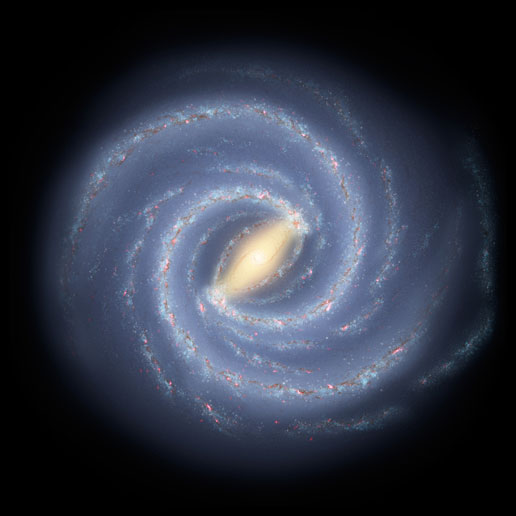
Our Milky Way Galaxy


This artist's concept illustrates the new view of the Milky Way
The artist's concept also includes a new spiral arm, called the "Far-3 kiloparsec arm," discovered via a radio-telescope survey of gas in the Milky Way. This arm is shorter than the two major arms and lies along the bar of the galaxy.

Our sun lies near a small, partial arm called the Orion Arm, or Orion Spur, located between the Sagittarius and Perseus arms.


The disk of Our Milky Way Galaxy is home to hot nebulae, cold dust, and billions of stars. This disk can be seen from a dark location on Earth as a band of diffuse light across the sky. This band crosses the sky in dramatic fashion in the above series of wide angle sky.

The deepness of the exposures also brings to light a vast network of complex dust filaments. Dust is so plentiful that it obscures our Galaxy's center in visible light, hiding its true direction. The Galactic Center, though, is visible above as the thickest part of the disk. The diffuse glow comes from billions of older, fainter stars like our Sun, which are typically much older than the dust or any of the nebulae. One particularly photogenic area of darkness is the Pipe Nebula visible above the Galactic Center. Dark dust is not the dark matter than dominates our Galaxy -- that dark matter remains in a form yet unknown.

Most bright stars in Our Milky Way Galaxy reside in a disk. Since our Sun also resides in this disk, these stars appear to us as a diffuse band that circles the sky. The above panorama of a northern band of the Milky Way's disk covers 90 degrees and is a digitally created mosaic of several independent exposures. Scrolling right will display the rest of this spectacular picture. Visible are many bright stars, dark dust lanes, red emission nebulae, blue reflection nebulae, and clusters of stars. In addition to all this matter that we can see, astronomers suspect there exists even more dark matter that we cannot see.

To study our Galaxy, theorists create models of how these different particles interact with magnetic fields in different locations and with different strengths. Astronomers can then compare these models to actual observations made at radio, infrared, optical, ultraviolet, and X-ray wavelengths to see how well they match the data. The LAT will contribute vital data that will enable theorists to constrain and improve their models.

The Galaxy

| 0 comments

A galaxy is a massive, gravitationally bound system that consists of stars and stellar remnants, an interstellar medium of gas and dust, and an important but poorly understood component tentatively dubbed dark matter. Galaxies may contain many star systems, star clusters, and various interstellar clouds. The Sun is one of the stars in the Milky Way Galaxy; the Solar System includes the Earth and all the other objects that orbit the Sun.


Types of galaxies according to the Hubble classification scheme. An E indicates a type of elliptical galaxy; an S is a spiral; and SB is a barred-spiral galaxy.

The study of galactic formation and evolution attempts to answer questions regarding how galaxies formed and their evolutionary path over the history of the universe. Some theories in this field have now become widely accepted, but it is still an active area in astrophysics.

Our own galaxy is a large disk-shaped barred-spiral galaxy about 30 kiloparsecs in diameter and a kiloparsec in thickness. It contains about two hundred billion (2×10¹¹) stars and has a total mass of about six hundred billion (6×10¹¹) times.

Despite the prominence of large elliptical and spiral galaxies, most galaxies in the universe appear to be dwarf galaxies. These galaxies are relatively small when compared with other galactic formations, being about one hundredth the size of the Milky Way, containing only a few billion stars. Ultra-compact dwarf galaxies have recently been discovered that are only 100 parsecs across.

Many dwarf galaxies may orbit a single larger galaxy; the Milky Way has at least a dozen such satellites, with an estimated 300–500 yet to be discovered. Dwarf galaxies may also be classified as elliptical, spiral, or irregular. Since small dwarf ellipticals bear little resemblance to large ellipticals, they are often called dwarf spheroidal galaxies instead.

A study of 27 Milky Way neighbors found that in all dwarf galaxies, the central mass is approximately 10 million solar masses, regardless of whether the galaxy has thousands or millions of stars. This has led to the suggestion that galaxies are largely formed by dark matter, and that the minimum size may indicate a form of warm dark matter incapable of gravitational coalescence on a smaller scale.

The realization that we live in a galaxy, and that there were, in fact, many other galaxies, parallels discoveries that were made about the Milky Way and other nebulae in the night sky.

.

 
© Copyright 2010-2011 What Is Galaxy All Rights Reserved.
Template Design by Herdiansyah Hamzah | Published by Borneo Templates | Powered by Blogger.com.